

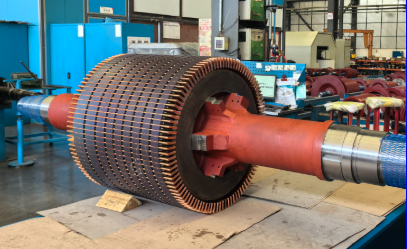
Rolling bearings and sliding bearings are the two primary types of support used in electric motors; each has distinct advantages in terms of operating principles, performance characteristics, and applications.
I. Fundamental Differences in Operating Principles
Rolling bearings support loads by using rolling elements—such as steel balls or rollers—that roll between an inner ring and an outer ring. This mechanism results in either “point contact” or “line contact.” Since rolling friction is significantly lower than sliding friction, the starting resistance is minimal, allowing for highly agile and effortless startup.
Sliding bearings, in contrast, operate on a completely different principle. They contain no rolling elements; instead, the rotating shaft rests directly upon a bearing shell (or bush), separated from it by an extremely thin film of lubricating oil. As the rotor rotates, the lubricant is drawn into the wedge-shaped gap between the shaft journal and the bearing shell, generating a hydrodynamic oil film that causes the shaft to “float” and operate atop this fluid layer. Under normal operating conditions, there is no direct physical contact between the shaft and the bearing shell; the system operates under conditions of pure fluid friction.
II. Differences in Structure and Maintenance
Rolling bearings are highly standardized, self-contained components comprising four main parts: an inner ring, an outer ring, rolling elements, and a cage. They feature a compact structure and offer excellent interchangeability. Installation typically involves simply pressing the bearing into its housing. Maintenance is relatively straightforward: the lubricant (grease) is periodically replenished or replaced, and if the bearing is damaged, it is replaced with a new unit, resulting in short repair cycles.
Sliding bearings, conversely, consist of an assembly comprising a bearing housing, bearing shells, a lubrication system, and other components. Their structure is complex, and they occupy a larger physical footprint. The bearing shells are often split (two-piece) designs to facilitate easier installation and maintenance. However, the maintenance procedures are considerably more involved, requiring regular inspection of oil quality, oil levels, and oil temperature, as well as continuous monitoring of vibration levels and bearing shell temperatures. Should the bearing shells become worn, they require specialized processes such as scraping (hand-fitting) or recasting with Babbitt metal; these repair procedures demand high technical precision and are time-consuming.
III. Trade-offs in Performance Characteristics
The primary advantages of rolling bearings include low starting resistance, rapid startup capabilities, a compact structure, excellent interchangeability, and simple maintenance. However, they are subject to fatigue life limitations; under alternating contact stresses, the rolling elements and raceways will eventually succumb to fatigue pitting or spalling. Furthermore, due to the impact of rolling elements and cage vibrations, operational noise levels tend to be relatively high. At high rotational speeds, the centrifugal forces generated by the rolling elements can also become a limiting factor on performance. The advantages of sliding bearings lie in their high load-carrying capacity, excellent shock resistance, and quiet, smooth operation. Lacking rolling elements, they inherently possess superior damping characteristics, enabling them to absorb vibrations and shocks effectively. Under ideal operating conditions—specifically, an intact oil film, clean lubricant, and normal temperatures—sliding bearings can theoretically operate indefinitely, as they are not subject to fatigue life limitations. However, they are highly dependent on the lubrication system; should the oil supply fail, the lubricant become contaminated, or the temperature spiral out of control, the bearing shells will rapidly burn out, resulting in severe accidents.
Post time: Mar-27-2026