

In the world of industrial motor applications, Variable Frequency Drives (VFDs) have become essential tools for energy savings and process control. A common question we encounter, especially from overseas buyers, is: “Can I use a standard IE4 grid-frequency motor with a VFD?” The short answer is yes, technically, you can. However, as a professional in the field, I must highlight that “can” does not mean “should” for every application.
Recently, a client compared our specialized Permanent Magnet Synchronous Motor (PMSM) to a standard IE4 induction motor, noting the price parity. At first glance, the standard motor seemed like a cost-effective solution. But the key difference lies in their design philosophy and operational range.
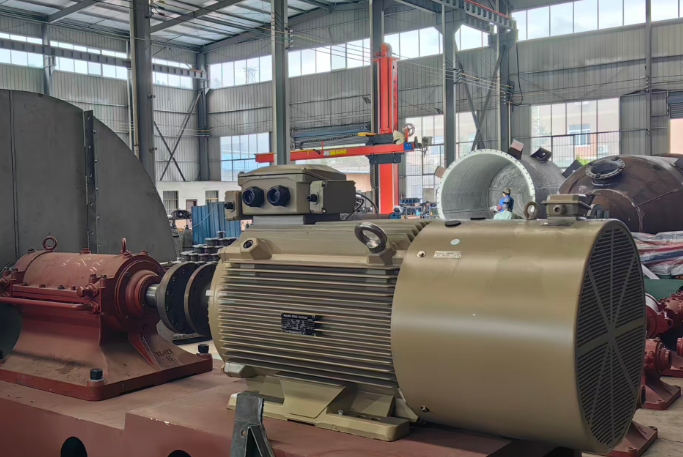
Standard grid-frequency motors (like IC 411 enclosed fan-cooled types) are engineered for constant speed operation, typically directly connected to the mains at 50Hz or 60Hz. When paired with a VFD, their performance faces significant limitations:
1. The Cooling Challenge (The 30-60Hz Trap)
The most critical issue is thermal management. Standard IC 411 motors rely on a shaft-mounted cooling fan. The fan speed is directly proportional to the motor speed. When you run the motor at low speeds (e.g., below 30Hz), the cooling fan also turns slower, drastically reducing its ability to dissipate heat. This can lead to rapid overheating, insulation damage, and eventual motor failure. This restricts the safe, continuous operational range to roughly 30–60Hz.
2. Torque and Efficiency at Low Speeds
Standard induction motors also experience reduced cooling and efficiency when operating outside their designed frequency range. While they can achieve IE4 efficiency at rated speed, this efficiency drops in variable speed scenarios without a dedicated cooling solution.
Therefore, while a standard motor + VFD setup works for basic, narrow-range applications (like some fans or pumps running near 50Hz), it is not a one-to-one substitute for a true variable-frequency motor.
For applications demanding wide speed ranges and consistent performance, a dedicated variable-frequency motor—such as a Permanent Magnet motor with independent cooling—remains the superior, safer, and more energy-efficient long-term investment.
Post time: Mar-13-2026