

In heavy industry, high-power motors (typically 200kW and above) are almost exclusively engineered as high-voltage (HV) motors—operating at 3kV, 6kV, or 10kV—rather than low-voltage (LV) 380V/660V systems. This design choice is rooted in fundamental electrical principles and delivers overwhelming advantages in efficiency, economics, and operational reliability.
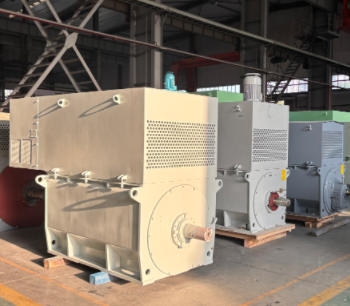
The core reason lies in the power equation: P = √3 × U × I × cosφ. For a fixed power output, voltage and current are inversely proportional. Doubling voltage halves current, which drastically reduces I²R copper losses—heat waste in windings and cables. A 1000kW LV motor draws ~1800A at 380V, while its HV counterpart draws only ~60A at 10kV. This massive current reduction is transformative.
First, system cost plummets. HV designs use far smaller cables, smaller switchgear, and eliminate costly step-down transformers—savings that quickly offset higher motor manufacturing costs. Second, efficiency surges: lower losses mean 3–5% higher energy efficiency, cutting long-term power expenses significantly. Third, performance stabilizes: minimal voltage drop enables stable long-distance power transmission, critical for mines, mills, and large plants. Finally, motor design improves: smaller current allows compact windings, better thermal management, and longer service life in harsh conditions.
While LV motors suit low-power applications, HV motors are non-negotiable for high-power industrial drives—delivering unmatched efficiency, economy, and durability for heavy-duty operations.
Post time: Apr-09-2026