

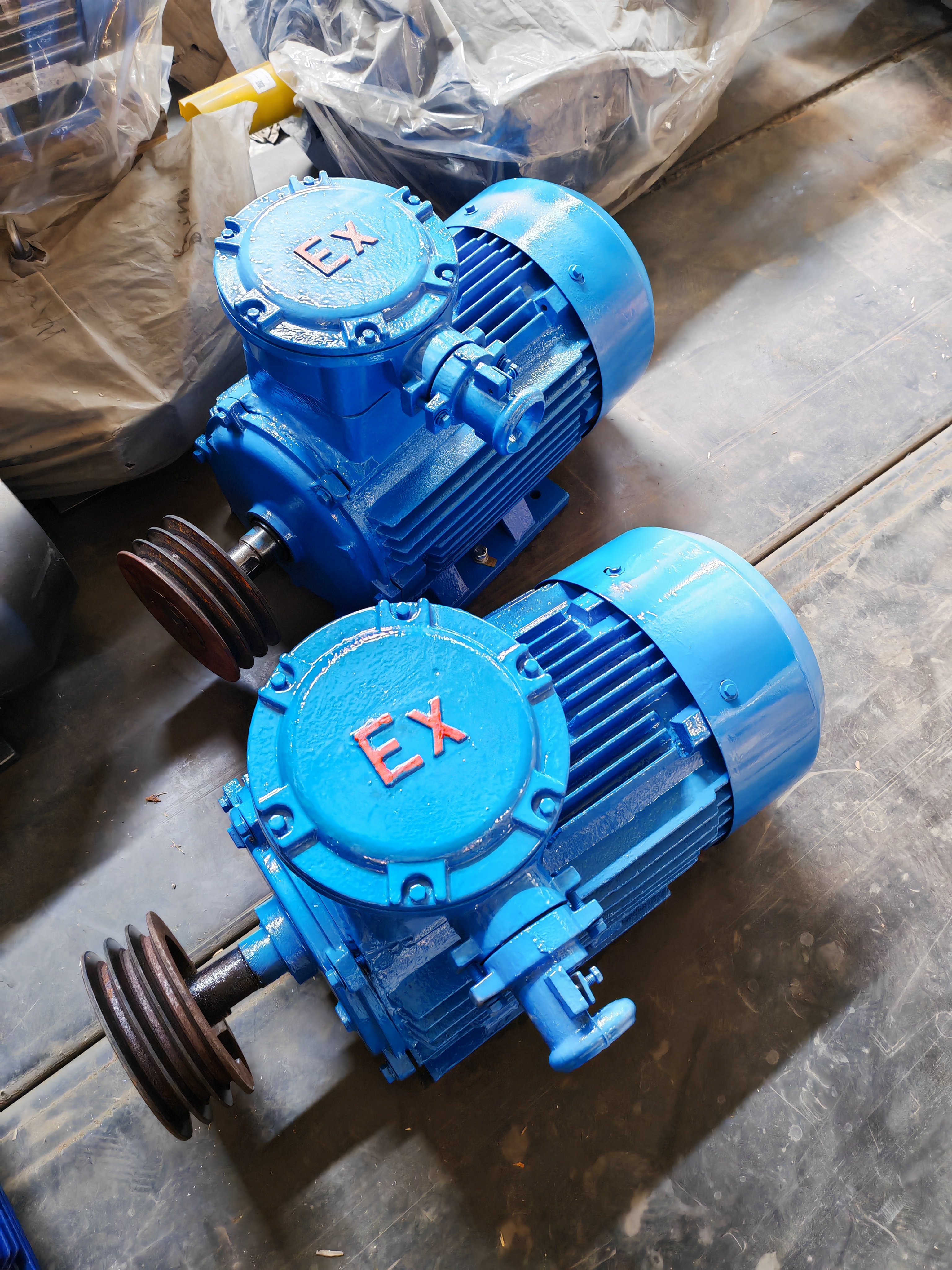
For explosion-proof motors, the surface roughness of the explosion-proof surface is crucial because it directly determines the motor’s explosion-proof performance—that is, its ability to prevent internal explosions from propagating to the outside.
If the roughness is unacceptable, even if the casing can withstand pressure, the explosion-proof function will still be lost. The core reasons are as follows:
1. Controlling the maximum gap (preventing flame propagation). The explosion-proof surface is not completely sealed; it allows for a certain gap (planar gap or cylindrical gap), but this gap must be controlled within a critical value.
Mechanism: When an explosion occurs inside the motor, the high-temperature, high-pressure flame and its products attempt to propagate to the outside through the gap in the explosion-proof surface. If the gap is appropriate, the high-temperature gas will absorb heat (cool) as it passes through the narrow gap, thus cooling to a level that cannot ignite the external explosive mixture by the time it reaches the outside.
The effect of roughness: If the explosion-proof surface is machined too roughly unevenly), those depressions and valleys microscopically effectively increase the actual gap value. Even if the surfaces appear to fit perfectly to the naked eye, microscopically, continuous channels allow flames to pass through, causing them to erupt directly and ignite the external environment.
2. Preventing Pressure Piling
Mechanism: If the explosion-proof surface is too smooth, although the seal is good, the internal pressure wave may not be able to escape in time during an explosion, leading to pressure buildup inside the casing that exceeds the shell’s strength limit (structural failure).
Standard Requirements: Therefore, standards (such as GB/T 3836.2) do not allow explosion-proof surfaces to be machined to a mirror-like shine (generally requiring a roughness Ra not exceeding 6.3μm, and polishing is not permitted). A certain degree of microscopic texture (such as fine machining marks) needs to be retained. These textures can dampen and absorb energy during an explosion, while ensuring the uniformity of gas pressure relief.
3. Preventing Corrosion and Uneven Gap
Mechanism: If the roughness is too high (Ra > 6.3μm), moisture and corrosive media easily accumulate in the valleys, causing the explosion-proof surface to rust. Rust further damages surface smoothness, leading to widened gaps or uneven stress on bolts after tightening, causing localized warping and deformation.
4. Maintenance and Parameter Preservation
Damage Resistance: Surfaces with a certain degree of roughness (rather than extreme smoothness) have a slightly higher tolerance for minor scratches during disassembly and maintenance. However, if the roughness is too high, the scratch depth is more likely to exceed the maximum permissible defect depth specified in the standard (usually not allowed to exceed 0.2mm or 0.5mm, depending on the standard), leading to motor failure.
Post time: Feb-28-2026