

In industrial settings dealing with pure oxygen or oxygen-enriched atmospheres, the approach to explosion protection requires a fundamental shift in thinking. Unlike environments with flammable gases or dusts, oxygen itself is not flammable but is a powerful oxidizer that dramatically accelerates combustion. This unique hazard renders many common explosion-proof motor types unsuitable and even dangerous.
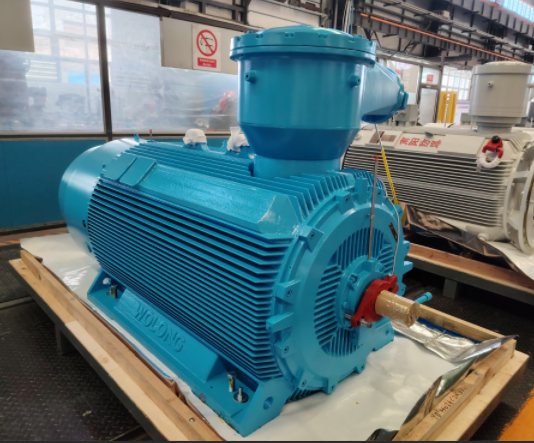
The Invisible Hazard: How Oxygen Changes the Risk Profile
An oxygen-rich environment (significantly above the normal 21% in air) drastically lowers the ignition energy required for materials. What might be a harmless spark or a warm surface in ambient air can become a potent ignition source. Metals, insulation, and lubricants that are stable in air can ignite violently in the presence of high-concentration oxygen.
Crucially, standard explosion-proof certifications like Ex d or Ex e are not designed for this risk. For instance, an “Ex d” flameproof enclosure is engineered to withstand an internal explosion of a specific gas. However, if pure oxygen infiltrates that same enclosure, any internal fault could cause an explosion of vastly greater pressure and temperature, potentially rupturing the housing.
Selecting the Right Motor: The Principle of Inertial Isolation
For equipment operating in designated oxygen service, the safety philosophy moves from “containing an explosion” to “preventing contact between oxygen and any potential ignition source.” Here are the viable technical pathways:
1. Pressurized Motors (Ex p) – The Preferred Solution
This is the most reliable and widely adopted method for oxygen applications. The motor enclosure is continuously purged and maintained at a positive pressure with an inert protective gas (like nitrogen). This creates a physical barrier, ensuring that external oxygen cannot enter the enclosure. Key to this system are continuous flow monitoring and interlocks that guarantee operational integrity. International standards (like IEC 60079-2) mandate that the oxygen content inside the enclosure be reduced and maintained below 2% by volume before and during operation.
2. Encapsulated Motors (Ex ma/mb)
For smaller motors or components, this method involves completely embedding potential arcing or sparking parts (like windings and terminals) in a resin compound. This seals them off from the surrounding oxygen atmosphere, provided the compound is compatible and remains intact.
3. Oil-Immersed Motors (Ex o)
This older technique submerges ignition sources in a protective fluid, creating a seal against oxygen. It is less common today due to maintenance and environmental considerations.
Prohibited Types and a Call to Action
It is imperative to understand that the following common protection types are not suitable and must be avoided in oxygen service:
Increased Safety (Ex e)
Non-Sparking (Ex n)
Post time: Feb-04-2026