

1. Overview of Common Cooling Structures
In the design of motor cooling systems, different power ratings typically adopt different approaches:
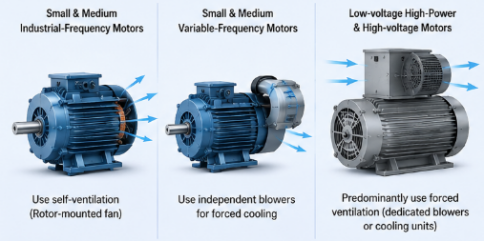
Small and medium-sized industrial-frequency motors generally use self-ventilation, relying on components such as the rotor-mounted fan to dissipate heat during normal operation.
Small and medium-sized variable-frequency motors, however, more often employ independent blowers for forced cooling, because speed variations can compromise the effectiveness of self-ventilation.
Low-voltage high-power motors and high-voltage motors predominantly adopt forced ventilation, requiring dedicated blowers or cooling units to manage temperature rise.
2. Root Cause Analysis
During operation, motors inevitably generate losses. These losses not only reduce efficiency but also manifest as heat, which is reflected in the motor’s temperature rise. Two key factors determine temperature rise performance: the magnitude of losses and the effectiveness of the cooling system.
2.1 Relative Loss vs. Absolute Loss
Relative loss determines the temperature rise level. High-efficiency motors have lower relative losses and therefore tend to run cooler.
Absolute loss, on the other hand, is directly proportional to motor capacity. For example, at the same efficiency level (i.e., same relative loss), a 185 kW motor has an absolute loss 10 times that of an 18.5 kW motor. For large motors, absolute losses can reach several kilowatts.
2.2 The Contradiction Between Heat Generation and Heat Dissipation
From a geometric perspective:
Motor losses scale approximately with volume (under similar electromagnetic loading);
Heat dissipation capacity scales approximately with surface area;
However, volume grows much faster than surface area as motor size increases. As a result, the amount of heat to be dissipated per unit surface area rises sharply—creating a “more heat generated, less surface to dissipate it” dilemma, which significantly worsens temperature rise.
2.3 Structural Factors Further Aggravate Thermal Issues
Large motors have more complex internal structures, leading to higher stray losses and longer, less direct heat dissipation paths. These factors can easily cause localized overheating, further compounding thermal management challenges.
3. Conclusion
In summary, the fundamental reason why large motors almost universally adopt forced ventilation is:
As motor power increases, absolute losses grow exponentially, while the increase in surface area for heat dissipation lags far behind the increase in heat generation. The resulting surge in unit-area thermal load makes self-ventilation insufficient to maintain safe operating temperatures.
Therefore, dedicated forced ventilation systems—or even more advanced cooling methods such as water cooling or hydrogen cooling—are essential for large motors to effectively control temperature rise and ensure reliable operation. Optimizing the cooling system is a core challenge in the design of high-power motors.
Post time: Jul-31-2026